In modern SEO, ranking well isn’t just about matching exact keywords—it’s about understanding search intent. This is where keyword stemming plays a crucial role.
Search engines like Google are smarter than ever. They don’t just look at individual words; they analyze variations, context, and meaning to deliver the most relevant results. Keyword stemming helps bridge the gap between what users search for and the content you create.
Let’s break it down.
What Is Keyword Stemming?
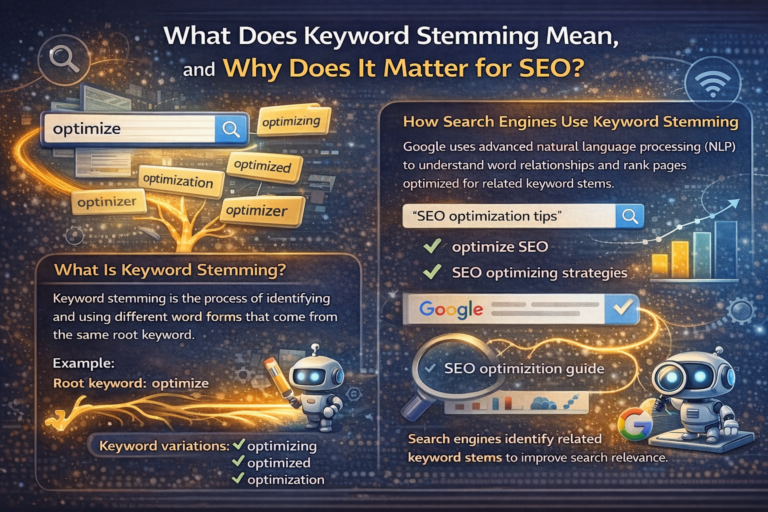
Keyword stemming is the process of identifying and using different word forms that come from the same root keyword.
Instead of focusing on one exact keyword, stemming allows search engines to recognize related variations of a word.
Example:
Root keyword: optimize
Keyword variations:
- optimizing
- optimized
- optimization
- optimizer
All of these stem from the same base concept, and search engines treat them as closely related.
This means your page can rank for multiple keyword variations—even if you don’t use each one explicitly.
How Search Engines Use Keyword Stemming?
Google uses advanced natural language processing (NLP) to understand word relationships. When a user searches for a term, Google doesn’t limit results to that exact phrase—it includes content that matches related stems and meanings.
For example:
Search: “SEO optimization tips”
Google may also rank pages optimized for:
“optimize SEO,” “SEO optimizing strategies,” or “SEO optimization guide”
This allows search results to be more accurate and helpful for users.
Why Keyword Stemming Matters for SEO?
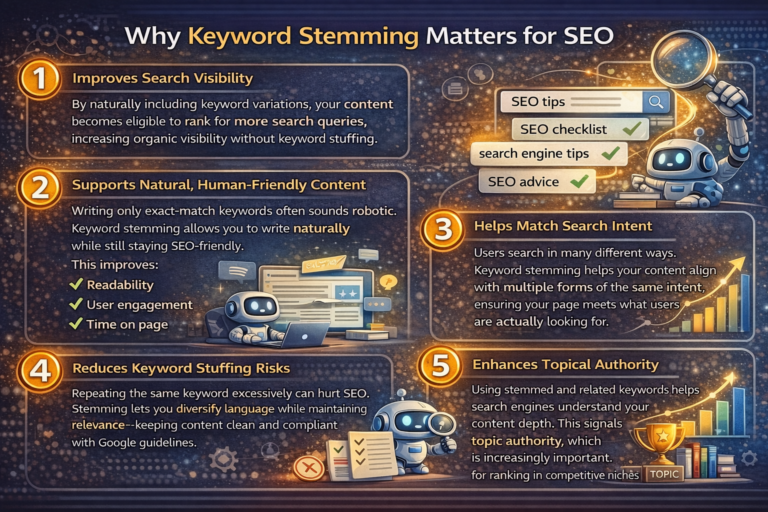
1. Improves Search Visibility
By naturally including keyword variations, your content becomes eligible to rank for more search queries, increasing organic visibility without keyword stuffing.
2. Supports Natural, Human-Friendly Content
Writing only exact-match keywords often sounds robotic. Keyword stemming allows you to write naturally while still staying SEO-friendly.
This improves:
- Readability
- User engagement
- Time on page
3. Helps Match Search Intent
Users search in many different ways. Keyword stemming helps your content align with multiple forms of the same intent, ensuring your page meets what users are actually looking for.
4. Reduces Keyword Stuffing Risks
Repeating the same keyword excessively can hurt SEO. Stemming lets you diversify language while maintaining relevance—keeping content clean and compliant with Google guidelines.
5. Enhances Topical Authority
Using stemmed and related keywords helps search engines understand your content depth. This signals topic authority, which is increasingly important for ranking in competitive niches.
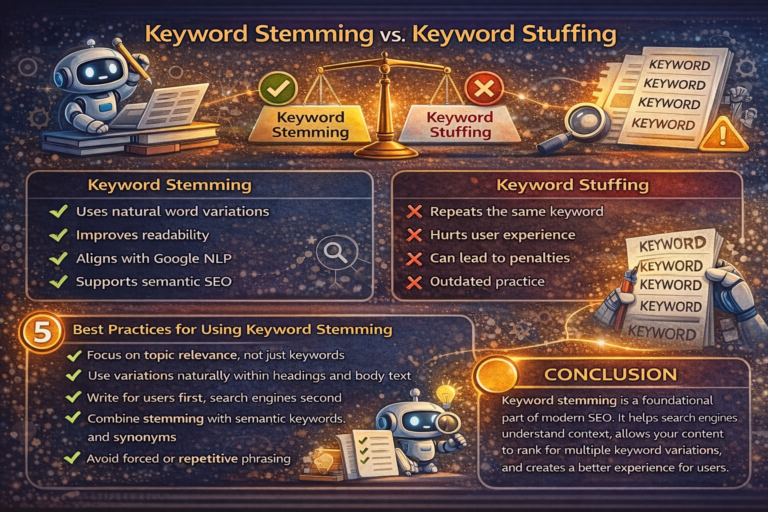
Keyword Stemming vs. Keyword Stuffing
| Keyword Stemming | Keyword Stuffing |
|---|---|
| Uses natural word variations | Repeats the same keyword |
| Improves readability | Hurts user experience |
| Aligns with Google NLP | Can lead to penalties |
| Supports semantic SEO | Outdated practice |
Best Practices for Using Keyword Stemming
- Focus on topic relevance, not just keywords
- Use variations naturally within headings and body text
- Write for users first, search engines second
- Combine stemming with semantic keywords and synonyms
- Avoid forced or repetitive phrasing
CONCLUSION
Keyword stemming is a foundational part of modern SEO. It helps search engines understand context, allows your content to rank for multiple keyword variations, and creates a better experience for users.
By using keyword stemming correctly, you move beyond exact-match optimization and build content that is natural, authoritative, and future-proof.
If you want to know more about Best SEO services, you can contact to our website https://deuscreation.com/